
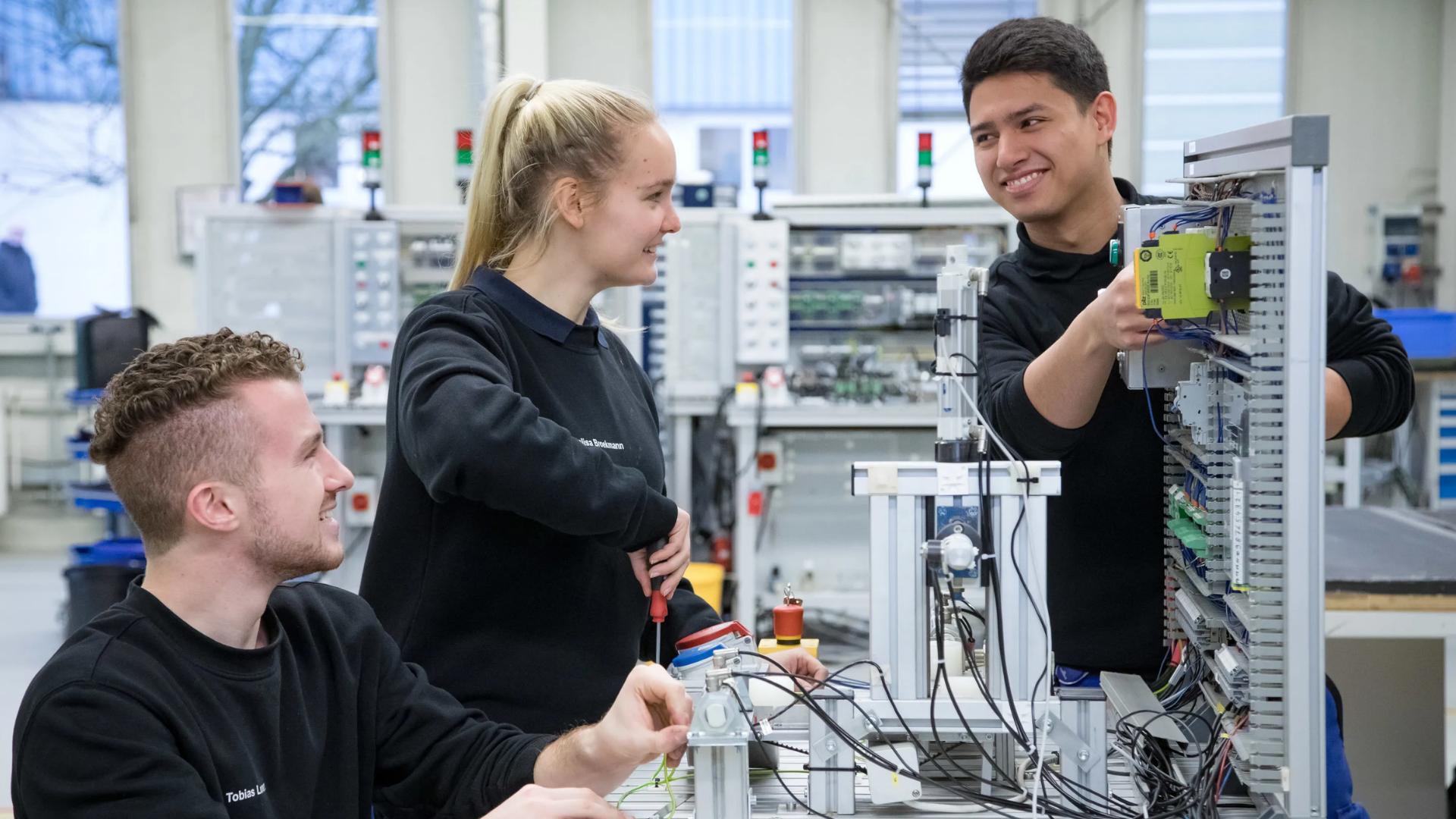
La Ausbildung es el sistema de formación profesional remunerada de Alemania que enseña una profesión tanto en el lugar de trabajo como en una escuela de formación profesional. En su forma más común, la Ausbildung dual (duale Ausbildung), pasas parte de la semana en una empresa y parte en la Berufsschule; suele durar entre 2 y 3,5 años y cobras un salario mientras te formas. Para solicitarla desde Turquía necesitas un contrato de Ausbildung (Ausbildungsvertrag), un nivel de alemán B1-B2 en la mayoría de las profesiones y un título escolar acorde al campo. En 2026 puedes hacer una Ausbildung en cientos de profesiones, desde enfermería hasta mecatrónica, y con una barrera de entrada mucho menor que la universidad.
¿Qué es la Ausbildung? ¿Por qué es tan popular?
En la base de la fuerza económica de Alemania hay una mano de obra cualificada formada no mediante títulos universitarios, sino mediante una educación profesional práctica. La Ausbildung es precisamente el nombre de este sistema: aprendes la teoría en el aula y haces la práctica en un lugar de trabajo real, por un salario real. Vista desde Turquía, destacan tres grandes ventajas.
- Es remunerada: a diferencia de la universidad, recibes un salario cada mes durante toda tu formación, de modo que vives en Alemania sin endeudarte.
- Está cerca de una garantía de empleo: al graduarse, la mayoría de los Azubis empiezan a trabajar en la misma empresa; la escasez de mano de obra cualificada en Alemania facilita esta transición.
- La barrera de entrada es baja: no se requiere una nota media alta ni una clasificación en un examen; lo que importa es tu nivel de alemán y tu motivación.
Si tu objetivo es una carrera académica, cubrimos la alternativa —la vía universitaria— en detalle en nuestra guía para estudiar en una universidad en Alemania. Este artículo, en cambio, se centra por completo en la formación profesional, es decir, en la Ausbildung.
Ausbildung dual y Ausbildung escolar: la diferencia
- Ausbildung dual (duale): firmas un contrato con una empresa; cobras un salario y asistes a la Berufsschule. Es el tipo más ventajoso para quienes solicitan desde Turquía, porque la garantía de ingresos facilita la solicitud de visado.
- Ausbildung escolar (schulische): algunas profesiones sanitarias y sociales se imparten principalmente en la escuela. Una parte no es remunerada; en ese caso puede que tengas que demostrar que puedes mantenerte (por ejemplo, una cuenta bloqueada).
Para la gran mayoría de quienes solicitan desde Turquía, la elección correcta es la Ausbildung dual, que ofrece seguridad de ingresos y un vínculo directo con un empleo.
Ausbildung frente a universidad: la diferencia
| Criterio | Ausbildung | Universidad (grado) |
|---|---|---|
| Duración | 2-3,5 años | 3-4 años |
| Ingresos | Salario desde el primer día | Ninguno (de hecho, un gasto) |
| Requisito de entrada | Contrato + alemán | Homologación + normalmente el examen de acceso |
| Enfoque | Profesión aplicada | Académico / teórico |
| Siguiente paso | Empleo directo | Máster / carrera |
Ambas vías conducen a la residencia permanente en Alemania. Al decidir cuál te conviene, te recomendamos sopesar juntos tus objetivos académicos y tu situación económica.
Profesiones de Ausbildung: ¿qué campos existen?
Alemania tiene más de 300 profesiones de Ausbildung reconocidas. Los campos más elegidos por quienes solicitan desde Turquía, y con mayor escasez de mano de obra, son los siguientes.
| Campo | Profesiones de ejemplo | Demanda |
|---|---|---|
| Salud | Enfermería (Pflegefachmann), cuidado de mayores | La más alta |
| Terapia | Fisioterapia | Alta |
| Técnico | Mecatrónica, electrónica, mecánica industrial | Alta |
| Logística | Conducción de camiones, logística de almacén | Alta |
| TI | Fachinformatiker (especialista en TI) | Creciente |
| Hostelería | Cocina, gestión hotelera | Media-alta |
Cubrimos algunos de estos campos en guías dedicadas: salarios de enfermería en Alemania, ser fisioterapeuta en Alemania y ser conductor de camión en Alemania. Si ya tienes una profesión en Turquía, la manera de que se reconozca en Alemania puede ser la homologación en lugar de una Ausbildung; explicamos ese proceso en nuestra guía de homologación (Anerkennung) en Alemania.
Requisitos de la Ausbildung y límite de edad
Para solicitar una Ausbildung desde Turquía, los requisitos básicos son los siguientes.
- Dominio del alemán: B1 para la mayoría de las profesiones, B2 para los puestos sanitarios y de atención al cliente.
- Título escolar: normalmente basta con un título de bachillerato; algunas profesiones también aceptan un nivel de secundaria inferior.
- Contrato de Ausbildung: un contrato firmado con una empresa que te acepte es el núcleo del proceso.
¿Hay un límite de edad? Legalmente no existe un límite de edad superior para una Ausbildung; hay quienes empiezan con 30 e incluso 40 años. En la práctica, algunas empresas pueden preferir candidatos más jóvenes, pero la escasez de mano de obra cualificada lo está flexibilizando. Lo decisivo no es tu edad, sino tu nivel de alemán y tu motivación.
¿Cómo se solicita una Ausbildung?
Desde Turquía, el proceso avanza con estos pasos.
- Preparación del alemán: alcanzar al menos el B1 antes de solicitar es el primer paso que abre puertas.
- Investigación de profesión y empresa: para los anuncios de Ausbildungsplatz, se usan los portales azubi.de, AzubiYo y la Agencia Federal de Empleo (Arbeitsagentur).
- Expediente de solicitud: te postulas a las empresas con un CV en alemán (Lebenslauf) y una carta de motivación.
- Entrevista y contrato: si te aceptan, se firma el Ausbildungsvertrag.
- Solicitud de visado: con el contrato, solicitas el visado de Ausbildung en el consulado.
Visado de Ausbildung y documentos necesarios
La entrada a Alemania para una Ausbildung se basa en un permiso distinto del visado de estudiante (Aufenthaltserlaubnis zur Berufsausbildung). Los documentos que se suelen pedir son los siguientes.
- Pasaporte válido y formulario de solicitud de visado
- Contrato de Ausbildung firmado
- Certificado de dominio del alemán (normalmente B1)
- Tu título escolar y sus traducciones
- Prueba de fondos o una cuenta bloqueada en el caso de una Ausbildung no remunerada (escolar)
Para agilizar tu proceso, el procedimiento acelerado §81a que puede iniciar el empleador es una ventaja; puedes ver los detalles en nuestra guía del visado acelerado §81a. Si aún no tienes un contrato, echa también un vistazo a nuestra guía de la Tarjeta de Oportunidad (Chancenkarte), que te permite venir a Alemania y buscar sobre el terreno.
Salario de la Ausbildung: ¿cuánto se gana mientras te formas?
El aspecto más atractivo de la Ausbildung dual es el salario que recibes durante toda tu formación (Ausbildungsvergütung). El importe varía según la profesión, el sector y el año, y aumenta de forma escalonada cada año.
- En 2026, la paga bruta mensual ronda los 1.000-1.300 € en la mayoría de las profesiones.
- En el campo de la salud (por ejemplo, la enfermería) los importes suelen estar en la franja alta.
- La paga aumenta en el 1.º, 2.º y 3.º año de formación.
Estos ingresos bastan en gran medida para cubrir el alquiler y los gastos básicos de manutención en Alemania; en comparación con la universidad, esta es la mayor diferencia financiera.
Requisito de alemán y preparación lingüística en la Ausbildung
La verdadera clave de todo este proceso es una sola cosa: el alemán. Conseguir un contrato, la aprobación del visado y tener éxito en el lugar de trabajo dependen de una base lingüística sólida. El B1 es el umbral mínimo; en campos como la salud, el B2 es prácticamente obligatorio.
 Línea de WhatsApp